OpenAI’s February 2026 threat report describes Date Bait, a romance-and-task scam combining social-media ads, an automated chatbot, Telegram conversations and human operators. ChatGPT and API access supported messages, translation and operational reporting; requests for escalating payments completed the fraud pathway. The report says associated accounts and an API customer were banned. Claims about victim volume and revenue rely on scammers’ own inputs and were not independently verified.
METR explains why its follow-up developer experiment did not provide a reliable estimate of current AI productivity gains. Developers increasingly avoided participation or withheld tasks they did not want to perform without AI; lower compensation added another selection concern. Concurrent agent use also complicated time accounting. The raw results suggested possible speedups but had wide uncertainty and omitted important users and tasks, prompting changes to the study design.
METR’s February 2026 modeling note builds a compact forecast of AI research automation from research labor, compute and software efficiency. Its equations connect capability progress to the share of tasks automated while representing remaining human work as a bottleneck. The accompanying model is useful for examining sensitivity to automation speed and research returns. The headline date follows selected parameter assumptions, many based on judgment, rather than an observed capability threshold.
METR’s December 2025 report organizes a snapshot of twelve developers’ published safety policies into nine categories. These include capability thresholds, model-weight protection, deployment safeguards, stopping conditions, evaluation practice, accountability and policy revision. The report is descriptive: a category comparison does not certify implementation, legal compliance or which policy is best.
 Play video
This AI Explained video reviews a major AI development through the lens of governance and responsible deployment. It is useful context for AI engineering, evaluation, governance, and operational risk.
Microsoft summarizes lessons from red teaming more than one hundred generative AI products, emphasizing system-level testing, human expertise, and automation.
 Play video
This AI Explained video reviews a major AI development through the lens of agentic workflows and tool-use risk. It is useful context for AI engineering, evaluation, governance, and operational risk.
 Play video
This AI Explained video reviews a major AI development through the lens of agentic workflows and tool-use risk. It is useful context for AI engineering, evaluation, governance, and operational risk.
 Play video
This AI Explained video reviews a major AI development through the lens of agentic workflows and tool-use risk. It is useful context for AI engineering, evaluation, governance, and operational risk.
 Play video
This AI Explained video reviews a major AI development through the lens of agentic workflows and tool-use risk. It is useful context for AI engineering, evaluation, governance, and operational risk.
 Play video
Rayan Krishnan shows why token prices and overall benchmark ranks can mislead model selection. Task mix, token consumption and the choice between partial credit and fully correct answers change the comparison. He describes replaying historical work and comparing cost against quality. Private savings figures and model rankings are examples, not independently verified results.
 Play video
Bridgewater’s Vault talk describes building a small, manually labeled search benchmark with relevant documents and plausible but unhelpful results. It measures top-ten precision and examines how date, source and asset filters affect retrieval. Human search and agent workloads need different load tests. Private benchmark scores and investment outcomes are not independently verified.
 Play video
Sofia Jakovcevic’s refund-agent example shows why an average score can hide a tradeoff: a prompt change improves action safety while reducing task completion. Her regression loop samples production traces, adds known failures and successful workflows, compares baseline and candidate runs, and gates changes on separate criteria. Demonstration scores are not a production effectiveness study.
 Play video
Ryan Ahern demonstrates historical web retrieval for an acquisition predictor. A winning entry memorizes the visible company list, exposing the need for held-out tests. Exa’s documentation adds a key limit: snapshot content predates the cutoff, but candidate discovery uses current retrieval signals. Missing snapshots, model memory, and test-set tuning can still bias a backtest; the workshop does not establish predictive performance.
 Play video
Pamela Fox’s workshop compares models on application tasks and turns calendar-tool behavior into checks of the selected tool and returned arguments. For less exact outputs, it records context and uses a judge that must itself be calibrated. Generated scenarios can bootstrap coverage, but a small demo score cannot establish which model is best for a production workload.
 Play video
Laurie Voss builds an evaluation loop around a demonstration research agent. A correctness judge rejects fresh facts it cannot verify, while a faithfulness check becomes useful when given the original search results and notes. The workshop combines deterministic checks, human-labeled examples, and separate development and test splits. Its small dataset illustrates calibration rather than establishing reliable production accuracy.
 Play video
Jemima Abu shows how missing accessibility requirements can produce verbose custom interfaces that need repair. Native HTML and established component patterns reduce avoidable implementation work, but automated scans alone miss interaction problems. The talk supports explicit requirements and manual evaluation; its small demonstration does not establish general cost savings.
 Play video
Eleonora Drykina and Nina Žižakić describe retrieval failures caused by flattened tables and fragmented document context. Their approach retains section paths and chunk order, combines lexical and semantic retrieval, and expands context when needed. The talk also shows why model-judge verdicts need source checks. Private retrieval results do not independently establish answer accuracy.
 Play video
Ido Salomon presents AgentCraft, which uses a strategy-game interface to make coding-agent activity easier to supervise. Suggested tasks become quests, an orchestrator can delegate a larger goal, and a review kit combines file changes with visual evidence. Shared rooms support collaboration between designers and engineers. The talk explores interface design and a simpler experimental product, without establishing measured usability or reliability gains.
 Play video
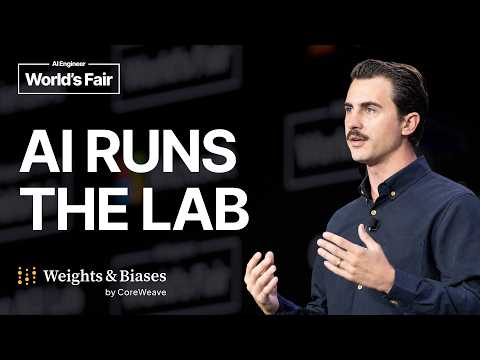
Tim Sweeney demonstrates ARIA launching GPU experiments, examining existing runs and producing visual reports inside Weights & Biases. Long-running training executes outside the conversation loop while the agent checks progress. He also describes turning reviewed traces into nightly evaluations. The live batch completes a research iteration without beating the earlier best result, illustrating that automated execution does not guarantee improvement.
 Play video
Devansh Tandon outlines language-based recommenders that represent catalog items with compact semantic IDs and train models to understand those IDs alongside natural language. User requests can then steer recommendations directly. He connects model scaling to feed economics, arguing that selecting existing content can require less inference than generating it. The cost ratios and consumer-market forecast are speaker claims rather than a complete operating-cost study.
 Play video
Christopher Manning traces language-model history before presenting Moonlake AI’s approach to physical simulation. His central distinction is between generating convincing observations and modeling how actions change objects and state. The proposed system combines reconstructed scenes, editable code and physics, then compares simulated behavior with reality. Its usefulness depends on capturing the details relevant to the intended task.
 Play video
Deepak Pathak describes Skild AI’s approach to learning across robot bodies using simulation and human video for pretraining, teleoperation for adaptation, and deployment experience for later training. Manipulation, stair navigation and damaged-hardware demonstrations illustrate different demands on the system. The proposed data loop and recovery examples do not establish success across arbitrary robots or environments.
 Play video
Cyrus Clarke explores physical interaction by connecting an OpenClaw agent to a 900-pin shape display. Reusable gestures aim to improve conversational timing, with generation, validation and human review shaping an emerging movement vocabulary. The demonstration raises questions about readable expression and user reactions to embodied AI. Apparent breathing or social presence describes the interaction, without establishing subjective experience.