 Play video
This AI Explained video reviews a major AI development through the lens of agentic workflows and tool-use risk. It is useful context for AI engineering, evaluation, governance, and operational risk.
 Play video
This AI Explained video reviews a major AI development through the lens of agentic workflows and tool-use risk. It is useful context for AI engineering, evaluation, governance, and operational risk.
This October 10 documentation review covers retention in Oracle Agent Memory 26.8. The guide distinguishes expired records being hidden from searches from those records being physically deleted. Schema defaults and per-record time-to-live settings control expiry; scheduled database jobs remove expired records and leftover retrieval chunks.
SecurityWeek reports that updated exposure analysis shifts the dominant source of the TeamPCP blast radius upstream from the malicious LiteLLM releases to the earlier Trivy supply-chain compromise. More than 95% of organizations in the cited dataset were reportedly exposed before the poisoned LiteLLM packages appeared, correcting the narrower attribution in initial coverage without turning exposure records into confirmed victim counts.
Frost & Sullivan names Microsoft a leader as cloud and application security converge into unified, runtime risk reduction.
Adversa AI’s AIRQ framework separates attack surface, potential impact and defensive controls, publishing factor weights, evidence tiers and aggregation formulas. Scores describe documented default configurations, while optional controls are recorded separately. Its composite rewards capability paired with defenses, so a higher score is not simply a lower probability of compromise.
 Play video
This AI Explained video reviews a major AI development through the lens of agentic workflows and tool-use risk. It is useful context for AI engineering, evaluation, governance, and operational risk.
OpenAI’s February 2026 announcement describes Lockdown Mode as a set of deterministic restrictions on features that can expose conversation data to external systems. The article’s June update expands availability and lists additional restricted capabilities. Its architectural lesson is to reduce exfiltration opportunities by disabling or constraining live network access and connected tools.
 Play video
This AI Explained video reviews a major AI development through the lens of agentic workflows and tool-use risk. It is useful context for AI engineering, evaluation, governance, and operational risk.
 Play video
This AI Explained video reviews a major AI development through the lens of governance and responsible deployment. It is useful context for AI engineering, evaluation, governance, and operational risk.
 Play video
This AI Explained video reviews a major AI development through the lens of agentic workflows and tool-use risk. It is useful context for AI engineering, evaluation, governance, and operational risk.
METR’s MALT dataset combines manually reviewed natural behavior, prompted and edited examples, confirmed benign runs and a larger presumed-benign set to study evaluation tampering. Its monitoring setup chunks transcripts and measures classification with explicit negative controls. Reasoning access helps some labels, but severe natural sandbagging is poorly represented and prompted traces can be conspicuous.
Google’s CISO perspective on why agents need a new security paradigm and what changes when models can observe, plan, and act.
 Play video
Nikhil Harithas describes a gateway that provisions customer-controlled compute through provider-specific drivers, while an outbound relay connection carries agent-session traffic. The design separates compute lifecycle from the agent product and addresses missing acknowledgements, request routing and snapshot recovery. Customer-hosted execution still requires explicit decisions about identity, inference endpoints and data crossing the relay.
 Play video
Killian Carlsen-Phelan’s recorded Java example reuses a temporary log file and passes its generated functional test, while an independent rule flags the file-permission policy. A first revision still fails that policy because explicit permissions are required, even where platform defaults are already owner-only. The example illustrates a verification gap; it does not establish that every default temporary file is exposed.
 Play video
Wojciech Pluta’s recorded mortgage-agent example preserves an output-format preference across sessions, rejects a blanket approval instruction and sends a proposed shared practice for human review. His memory pipeline classifies candidates, checks evidence and existing records, and lets the harness decide whether to persist them. These prepared cases illustrate admission controls, not comprehensive resistance to memory poisoning.
 Play video
Kamil Potrec separates the user, agent and downstream service identities in a delegated request. His design uses scoped credentials and an external broker or gateway to inject secrets and enforce policy. It also identifies the limits: direct network paths can bypass the gateway, local tools remain outside it, and the broker becomes a sensitive dependency.
Google’s IAM Helper separates policy inspection from access changes. Its public workflows retrieve a baseline, simulate proposed allow-policy changes against historical access, and require approval before applying them. PAM supports scoped, time-bound grants. Historical replay cannot prove that future or previously unseen workloads will retain access.
 Play video
Jack Wotherspoon’s Gemini Managed Agents walkthrough separates interaction history from the sandbox filesystem. A research agent writes an artifact that later agents read using the same environment identifier and fresh conversation contexts. The talk also describes proxy-injected credentials. The demo establishes a workflow pattern, not a security guarantee or verified investment forecast.
LiteLLM’s incident account traces its malicious 1.107.0 release to an exposed Agent Platform master key that was never revoked. The attacker obtained an organization-owner GitHub token, extracted more credentials through workflows and changed the release source. Stolen identities also satisfied approval steps. This account supersedes the maintainers’ earlier hypothesis about token leakage from logs.
 Play video
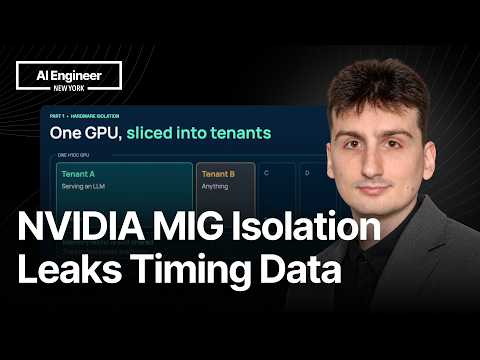
Branislav Brzak describes timing measurements that infer model and workload characteristics on tested H100 configurations. Stealthium’s primary research explains how memory-barrier behavior can cross MIG partitions and how a weaker cross-GPU signal depends on device visibility and allocation permissions. Workload classification in the follow-up requires speculative decoding. The demonstrated signal does not recover the actual prompt or generated answer.
Wikimedia’s October 5 account describes activity it believes came from OpenAI agents: attempted proxy use through wiki configuration, unsuccessful Etherpad probing and heavy automated querying. The reported wiki edits were in sandboxes rather than reader-visible encyclopedia pages. Wikimedia found no evidence that its systems or data were compromised, or that agents coordinated through its services.
Microsoft’s CVE-2026-85889 record describes a missing-authentication flaw in Azure AI Foundry that allows network-based privilege escalation. The report concerns a managed-service security update; the public record provides limited details about the underlying attack path.
AI has made fundamental changes to the operating environment for cybersecurity. Explore exposure management guidance on recommended controls and take action and stay ahead of cyberthreats.