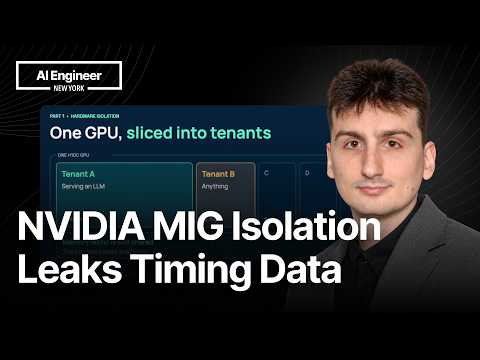
Branislav Brzak describes timing measurements that infer model and workload characteristics on tested H100 configurations. Stealthium’s primary research explains how memory-barrier behavior can cross MIG partitions and how a weaker cross-GPU signal depends on device visibility and allocation permissions. Workload classification in the follow-up requires speculative decoding. The demonstrated signal does not recover the actual prompt or generated answer.
Shared-GPU timing research: distinguish isolation from workload confidentiality
Related research
More curated notes connected through Adversarial ML and Agent Security.
OWASP Top 10 for Agentic Applications for 2026
OWASP's community guide organizes agentic-system risk into ten categories, including goal hijacking, tool misuse, identity and privilege abuse, memory poisoning, insecure inter-agent communication, cascading failures, and rogue-agent behavior. It provides a shared taxonomy and mitigation starting point rather than a certification checklist or evidence that a deployed system is secure.
A five-step roadmap to closing the AI evaluation gap
The roadmap addresses evaluation results that overstate real-world performance or fail to transfer across deployment contexts. Its five steps balance standardized and local tests, evaluate throughout the lifecycle, build qualified assurance and communication capacity, tailor tests to each value-chain actor and technology, and use a coordinated, trusted process for updating methods.
FinBot CTF Is Live: A Hands-On Companion to the OWASP GenAI Security Project
OWASP FinBot is a hands-on agentic-security CTF built around a simulated multi-agent financial-services platform with real tool access. Its challenges cover prompt injection, tool misuse, policy bypass, data exfiltration, privilege escalation, remote code execution, shared context, and compromised MCP servers.