Trail of Bits describes supervising GPT-5.5-Cyber as it built ASan and UBSan variants, derived seed corpora, and wrote fuzz harnesses for roughly a dozen zlib entry points in one day. The useful result is the workflow and its emphasis on reachability and reportability; vulnerability details remain under coordinated disclosure and the speed comparison is the authors' estimate.
 Play video
A systematic study of server-side browsers used by AI search and web-browsing services reports remote-code-execution paths in six leading services with a combined user base above one billion. The work covers domain-allowlist bypasses, JavaScript-restriction evasion, remote browser fingerprinting, service disruption, output manipulation, and server compromise.
Anthropic red-team research assessing how LLMs affect exploitation of known vulnerabilities. Relevant to cyber capability evaluation, benchmark design, and misuse risk modeling.
GPT-Rosalind advances life sciences research with enhanced biological reasoning, medicinal chemistry expertise, genomics analysis, and experimental workflow capabilities.
Introducing GPT-5.5, our smartest model yet—faster, more capable, and built for complex tasks like coding, research, and data analysis across tools.
OpenAI introduces GPT-Rosalind, a frontier reasoning model built to accelerate drug discovery, genomics analysis, protein reasoning, and scientific research workflows.
OpenAI’s March report describes asynchronous review of internal coding-agent conversations, reasoning and tool activity, with suspicious interactions escalated to human responders. The reported system reviewed interactions within 30 minutes of completion; blocking actions before execution was future work. Matching known employee escalations did not establish the false-negative rate on open-ended traffic.
OpenAI’s Codex Security explanation uses a redirect-validation example to show how a security check can stop constraining input after decoding or normalization. Its described workflow starts from repository context and trust boundaries, reduces hypotheses to testable code slices, and uses sandbox execution or constraint solving to validate findings.
In a recent evaluation of AI models’ cyber capabilities, current Claude models can now succeed at multistage attacks on networks with dozens of hosts using only standard, open-source tools, instead of the custom tools needed by previous generations.
Google Cloud outlines a defense-in-depth view of AI security spanning application controls, data protections, and infrastructure isolation.
 Play video
Steven Latré describes comparing coding agents across models, harnesses and GPU configurations using SWE-bench Pro. The method measures resolved tasks, latency, concurrency and hardware occupancy together: similar task scores can hide different token use and GPU time. The talk covers one workload and promises a broader public dataset; its break-even percentages are not portable purchasing guidance.
CrowdStrike reports a human-directed ARTEX campaign against more than 200 organizations, with post-exploitation confirmed at nine. Recovered transcripts link agent workflows to unsigned SAML assertions, cloud metadata access, unrotated mail keys and endpoint coverage checks. The target count is not a breach count, and the second commercial model remains unidentified.
 Play video
Shy Ruparel’s payout example keeps workflow decisions deterministic and records model calls, tool results and human approvals in durable history. A worker restart can reuse completed activities while an in-flight activity may retry. The talk uses synthetic payments and switches to a recording after the live restart stalls; it does not prove exactly-once external effects.
 Play video
Sonar’s ticketing-app workshop demonstrates three review cases: refunding a transferred ticket, displaying a fee outside the advertised total, and scanning one ticket twice. It adds written business rules and a required CI check before demonstrating automated fixes. These are prepared examples of verification gaps, not evidence of general reviewer accuracy or safe autonomous merging.
Dream’s updated investigation identifies a PHP2Shell and kernel-exploit chain against exposed PAN-OS management interfaces. Unit 42 says it verified the attacker’s tooling and reported results. Recovered artifacts show tunnels, extracted LDAP credentials and directory enumeration; later password spraying and account-creation outcomes remain unknown. AI assistance is an assessment, not proof of autonomy.
 Play video
Fuad Ali’s workshop follows a toy-shopping agent from trace review to a failure dataset, evaluator, proposed fix and comparison run. A planted filter bug produces redundant searches; the walkthrough checks whether the fix removes that behavior without breaking other requirements. Human review remains central to confirming issues, curating examples and judging fixes. Demo scores are not general release thresholds.
 Play video
SallyAnn DeLucia’s workshop turns travel-agent traces into an evaluation dataset. It defines concrete success and failure criteria, selects the spans containing the required evidence, maps their fields into a judge prompt and inspects labels with explanations. Human annotations then check judge agreement. The exercise is a starting workflow, not evidence that automated scores are reliable by default.
 Play video
Al Chen describes two failures that status dashboards can miss: a successful backup job can restore stale data, and a judge’s explanation can repeat sensitive input even when the main UI is redacted. He proposes checking restored records and controlling which judge outputs persist. A second judge or a redacted display alone does not establish that every data path is safe.
 Play video
Francesco Galletta and Felippe Felisola Caso use a wedding-budget demo to connect tested calculations with evidence lineage. Inputs are distinguished as sourced facts, assumptions, or interpretations, and reviewer challenges feed back into the plan. Repeatable arithmetic can still use wrong assumptions or changed code. The speakers present a design example in a personal capacity, not a verified Monzo deployment.
 Play video
CJ Avilla and Harrison Stall demonstrate controls around managed multi-agent work: scoped tools, network limits, vault credentials, budgets, and interrupts. Official documentation adds crucial limits: access to an allowed host does not restrict every operation, echoed responses can expose secrets, and some in-flight work can finish after a stop. These controls require validation; the demo does not prove safe operation at scale.
Langflow advisories describe command execution through MCP stdio configurations. Version 1.9.0 addressed one API path; the related advisory identifies 1.10.3 as the fix covering flow configurations and the execution boundary. Default auto-login can expose the authenticated functionality without credentials. Reported honeypot activity shows attempted exploitation, not a count of compromised deployments.
 Play video
Alvin Pane describes measuring baseline variation before changing prompts, caching, or model size. Repeated production and candidate runs help distinguish normal inconsistency from regressions, followed by review of changed outcomes. The synthetic example illustrates a testing workflow, not verified savings. Agreement between runs measures consistency and can still conceal a shared wrong answer.
 Play video
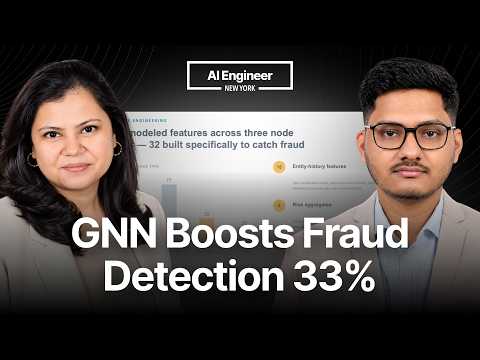
Somya Rai and MD Sharique describe adding graph embeddings to an XGBoost fraud classifier. Their engineering walkthrough covers user-history sampling, disjoint monthly graphs, past-only neighbors, training-only preprocessing, and cached representations for serving. The transferable method is to check temporal leakage and compare detection at the same analyst alert budget. Proprietary portfolio results and projected financial gains are not independently verified.
 Play video
Corey Gallon separates three checks: verify the delivered artifact, reconcile independent extractions against original sources, and challenge conclusions with fresh reviewers. His companion article and public agent-review instructions make the workflow inspectable. A matching fingerprint proves artifact identity, while balanced totals can still hide shared errors. The reported session analysis measures failures in one sample, not the effectiveness of the review method.