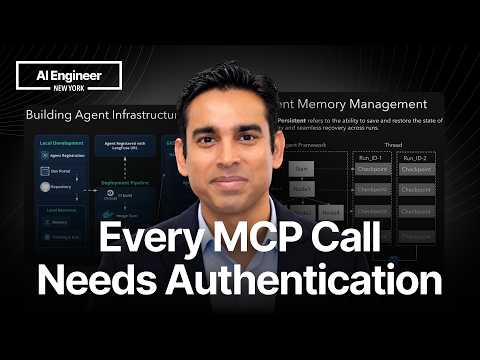
Harish Gaggar describes an enterprise agent platform combining a registry, workload identities, an MCP gateway, tracing, and approval steps for sensitive writes. The architecture links agent provisioning with tool access and data handling. These are useful enforcement points to inspect, but the presentation does not prove that its private controls prevent misuse or that a gateway alone confines an agent.
Enterprise agents: test identity, sensitive-action approval, and data handling
Related research
More curated notes connected through Agent Security and AI Engineering.
Pacing model development in an era of cyber-critical capabilities
OpenAI says preliminary evidence that Astra may meet its Critical cybersecurity threshold led it to pause frontier reinforcement-learning work for two weeks and keep its largest planned run on hold. New safeguards include stronger workload and network isolation, continuous boundary testing, token-level monitoring that escalates suspicious tool activity, and broader alignment checks for deception, reward hacking, and unauthorized access.
OWASP Top 10 for Agentic Applications for 2026
OWASP's community guide organizes agentic-system risk into ten categories, including goal hijacking, tool misuse, identity and privilege abuse, memory poisoning, insecure inter-agent communication, cascading failures, and rogue-agent behavior. It provides a shared taxonomy and mitigation starting point rather than a certification checklist or evidence that a deployed system is secure.
A blueprint for democratic governance of frontier AI
OpenAI proposes a three-part U.S. frontier-AI governance model: harmonize emerging state safety laws into a federal baseline, strengthen CAISI as an evaluation and standards institution, and coordinate a broader resilience program. Proposed controls include severe-risk evaluations, transparency reports, independent audits, safety-incident reporting, model-weight security, whistleblower protection, and periodic technical assessments.