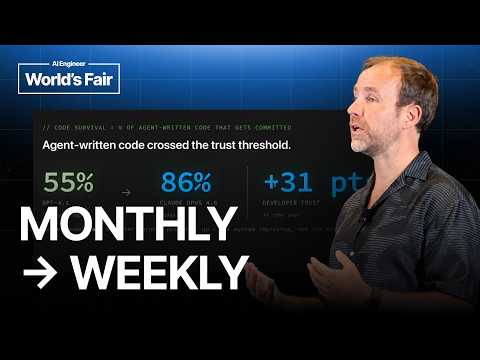
Harald Kirschner describes feeding production failures and developer corrections back into coding-agent evaluation. The workflow groups error traces, routes actionable failures to owners, creates candidate fixes, and checks changes before staged rollout. The VS Code team’s published evaluation work gives a complementary example: repeatedly running a tiny task while recording full tool sequences can reveal overhead that a pass/fail score misses. A smoke test cannot stand in for a diverse task suite, and code survival or release frequency does not by itself prove software quality. The reusable method is traceable regression feedback with controlled release exposure.
Close the coding-agent feedback loop with failure traces and staged releases
Related research
More curated notes connected through Model Evaluation and AI Engineering.
Pacing model development in an era of cyber-critical capabilities
OpenAI says preliminary evidence that Astra may meet its Critical cybersecurity threshold led it to pause frontier reinforcement-learning work for two weeks and keep its largest planned run on hold. New safeguards include stronger workload and network isolation, continuous boundary testing, token-level monitoring that escalates suspicious tool activity, and broader alignment checks for deception, reward hacking, and unauthorized access.
A blueprint for democratic governance of frontier AI
OpenAI proposes a three-part U.S. frontier-AI governance model: harmonize emerging state safety laws into a federal baseline, strengthen CAISI as an evaluation and standards institution, and coordinate a broader resilience program. Proposed controls include severe-risk evaluations, transparency reports, independent audits, safety-incident reporting, model-weight security, whistleblower protection, and periodic technical assessments.
OpenAI’s Frontier Governance Framework
OpenAI's 22-page Frontier Governance Framework maps its frontier-model processes to California's Transparency in Frontier AI Act and the EU AI Act's general-purpose AI code. It documents lifecycle risk assessment, cyber-offense and other risk tiers, mitigation and residual-risk decisions, critical-incident handling, security risk management, model reporting, external review, responsibility allocation, and change control.