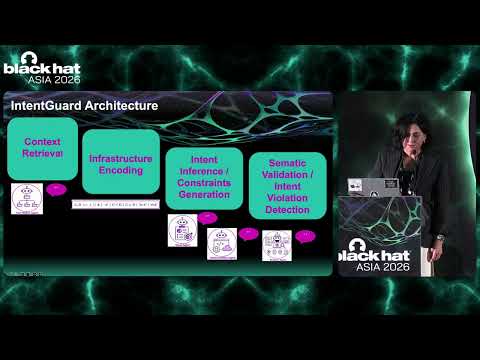
IntentGuard addresses infrastructure-as-code that is syntactically valid yet violates what a service is meant to do. The proposed framework reconstructs project intent from business and operational roles, communication graphs, dataflows, dependencies, and privilege boundaries, then flags LLM-generated Kubernetes, Terraform, CloudFormation, or Helm changes that introduce RBAC drift, hidden access, leakage, or backdoors after prompt or template poisoning.
Black Hat Asia 2026 | IntentGuard: Securing LLM-Generated Cloud Configurations
Related research
More curated notes connected through AI Red Teaming and Agent Security.
Pacing model development in an era of cyber-critical capabilities
OpenAI says preliminary evidence that Astra may meet its Critical cybersecurity threshold led it to pause frontier reinforcement-learning work for two weeks and keep its largest planned run on hold. New safeguards include stronger workload and network isolation, continuous boundary testing, token-level monitoring that escalates suspicious tool activity, and broader alignment checks for deception, reward hacking, and unauthorized access.
OpenAI’s Frontier Governance Framework
OpenAI's 22-page Frontier Governance Framework maps its frontier-model processes to California's Transparency in Frontier AI Act and the EU AI Act's general-purpose AI code. It documents lifecycle risk assessment, cyber-offense and other risk tiers, mitigation and residual-risk decisions, critical-incident handling, security risk management, model reporting, external review, responsibility allocation, and change control.
Cybersecurity in the Intelligence Age
OpenAI proposes a five-pillar strategy for AI-enabled cyber defense: tiered access for trusted defenders, faster government-industry coordination, stronger protection of frontier models and infrastructure, risk-scaled deployment monitoring, and broader defensive support for individuals and small organizations.