AI Engineer · November 23, 2026

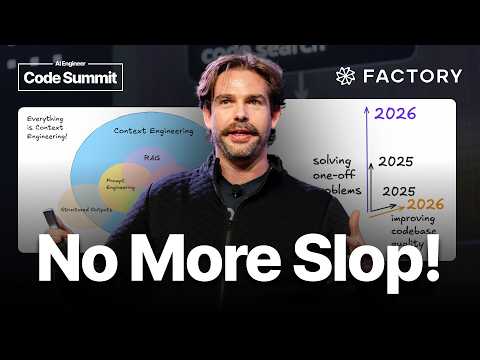
Use the next change to test whether agent-written code is maintainable

Use the next change to test whether agent-written code is maintainable video thumbnail
Why it matters

Dex Horthy tests maintainability by giving an agent a second requirement after the first passes. An implementation can pass its original checks yet be expensive to change. He recommends matching verification to the artifact, such as inspecting a browser preview for visual work, and turning repeated mistakes into deterministic checks. Planning effort should reflect the cost of a wrong decision, especially for persistent changes such as database schemas.

My takeaway: Choose a recently accepted agent change and add a realistic follow-up requirement. Record the rework, convert a recurring defect into a lint rule or regression test, and give reviewers the artifact that demonstrates the change.
Keep exploring

More curated notes connected through Model Evaluation and AI Engineering.

OpenAI News · framework

Pacing model development in an era of cyber-critical capabilities

OpenAI says preliminary evidence that Astra may meet its Critical cybersecurity threshold led it to pause frontier reinforcement-learning work for two weeks and keep its largest planned run on hold. New safeguards include stronger workload and network isolation, continuous boundary testing, token-level monitoring that escalates suspicious tool activity, and broader alignment checks for deception, reward hacking, and unauthorized access.

OpenAI News · framework

A blueprint for democratic governance of frontier AI

OpenAI proposes a three-part U.S. frontier-AI governance model: harmonize emerging state safety laws into a federal baseline, strengthen CAISI as an evaluation and standards institution, and coordinate a broader resilience program. Proposed controls include severe-risk evaluations, transparency reports, independent audits, safety-incident reporting, model-weight security, whistleblower protection, and periodic technical assessments.

OpenAI News · framework

OpenAI’s Frontier Governance Framework

OpenAI's 22-page Frontier Governance Framework maps its frontier-model processes to California's Transparency in Frontier AI Act and the EU AI Act's general-purpose AI code. It documents lifecycle risk assessment, cyber-offense and other risk tiers, mitigation and residual-risk decisions, critical-incident handling, security risk management, model reporting, external review, responsibility allocation, and change control.